Calibration answers the question from Part 4: reference anchoring. The device needs to know where “neutral” is for this user in this position before it can classify any motion as a gesture. That baseline is captured once after pairing — user holds arm in wearing position, firmware collects rotation vector samples, computes average, stores as the reference.
The original implementation required the user to hold still for up to two minutes. This is not a product.
The cause: MASR throttling
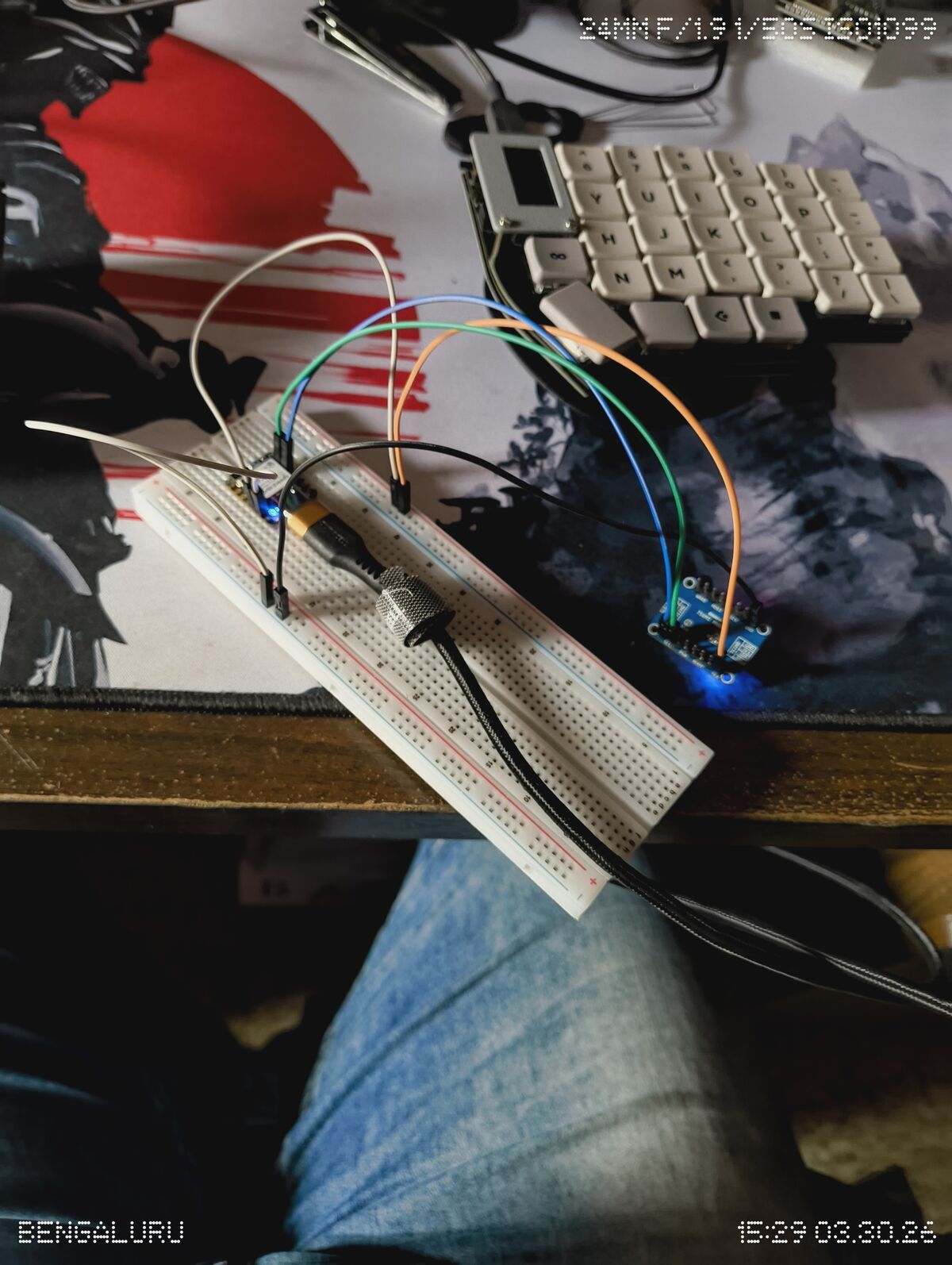
The BNO085 has a feature called Motion Adaptive Sample Rate. When it detects that the device is stationary, it automatically throttles the ROTATION_VECTOR report rate to save power.
Throttled rate: approximately 0.12 Hz.
The original calibration algorithm waited for 25 samples to fill the buffer. At 0.12 Hz, that’s 208 seconds worst case. In practice, 60–120 seconds. The user has to stand there, arm raised in wearing position, not moving, while the sensor slowly decides it might be worth sending another quaternion.
The log tags confirmed it — [RVRate] showed 0.12 Hz during the calibration window, [CalBuf] showed samples trickling in one every 8 seconds.
The fix: wall-clock deadline, two buffers
The rewrite (docs/CALIBRATION_REWRITE.md, implemented in 88aa7d7) makes one structural change: stop waiting for a sample count, use a fixed time deadline instead.
3-second collection window, started when arm event fires.
Two buffers:
  calBuffer       — ALL rotation vector samples during window
  stableCalBuffer — samples received while BNO085 stability = STABLE (stab=3)

Finalization priority (at 3-second expiry):
  1. stableCalBuffer.count > 0  →  baseline = mean(stableCalBuffer)
  2. calBuffer.count > 0        →  baseline = mean(calBuffer)
  3. both empty                 →  fail, app retries
The key detail is where the timer check lives:
// In loop(), before waitForEvent() — fires on every iteration
if (calInProgress && !baselineCaptured) {
  if (millis() - calStartMs >= CAL_WINDOW_MS) {
    finalizeCalibration();
  }
}
Not in the IMU event handler. Not gated on receiving a sample. In loop(), unconditionally, on every pass. If the IMU is throttled to 0.12 Hz and sends zero samples during the 3-second window, the timer still fires. The fallback path handles it.
The stability window
The BNO085 reports a stability class with each rotation vector sample:
| stab value | Meaning |
|---|---|
| 1 | On table |
| 2 | Stationary |
| 3 | Stable — sensor confident in orientation |
| 4+ | In motion |
stab=3 is what you want for calibration — the sensor is confident. Samples collected during stab=3 go into stableCalBuffer. When stab rises above 3 (motion detected), the window pauses but stableCalBuffer is not cleared; prior stable samples are retained across brief motion spikes.
// In handleStabilityClassifier()
if (calInProgress && !baselineCaptured) {
  if (stab == STABILITY_STABLE) {
    inStableWindow = true;
  } else if (stab >= 4) {
    inStableWindow = false;
    // stableCalBuffer NOT cleared — keep prior stable samples
  }
}
If the user’s arm is reasonably still during the 3-second window, stableCalBuffer fills with a handful of high-confidence samples. If the arm was moving the whole time, the fallback to calBuffer (all samples) gives a noisier but usable baseline.
State resets
Calibration state resets on three events:
- Disarm — user explicitly disarms via app
- BLE disconnect — connection dropped
- App writes
-999,-999,-999to the baseline characteristic — the protocol sentinel for “start over”
All three clear both buffers and the inStableWindow flag. The -999 sentinel is a deliberate API contract: the app can trigger a fresh calibration without bouncing the BLE connection.
The EARS requirements document (CALIBRATION_REWRITE.md) has 18 requirements covering every state transition. The full checklist is there if you want to understand why each reset path needs its own handling.
Result
Happy path timing: arm → user raises arm (1s of motion) → stab=3 fires → stableCalBuffer starts collecting → 3-second expiry → baseline set. Total: 3–4 seconds.
Log confirmation:
[Arm] armed
[Reports] rotation vector enabled
[RVRate] sample=10 elapsed=200ms (~50Hz)
[CalBuf] count=1/25 ...
[Cal] stable window used: 8 samples
[Cal] baseline: r=12.3 p=-8.1 y=44.7
The app does not forward gestures to the host while calibrationComplete == false. That gate lives in TypeScript, not firmware — separation of concerns. Firmware captures baseline. App enforces the gate. Each side owns its piece.
What’s still open
Sample rate at 50Hz fills 25 samples in ~500ms. The 3-second window is generous — the actual fill time is fast when the IMU isn’t throttled. The open question is whether the MASR throttle kicks in during the calibration window for certain users who hold very still. The log tags exist to detect this. The fallback path handles it. But characterizing the failure rate across different conditions is ongoing.
The multimeter and the serial monitor are the tools. The protocol gives you the visibility.